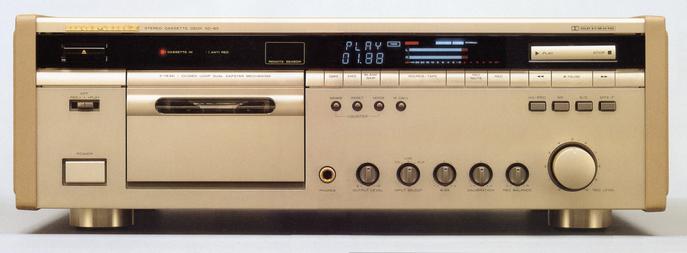
Marantz SD-60
¥ 65,000 (around 1989)
Commentary
A 3-head cassette deck developed with the concept of thorough pursuit of basic performance.
In order to realize the ideal tape travel, we are thoroughly pursuing the travel mechanism.
It uses a newly developed precision die-cast integrated head base and integrates parts that affect running performance, such as capstan & pinch roller head block and cassette guide pins. The combination with a precision large flywheel with a large inertial mass dramatically improves running performance.
In addition, the closed-loop dual-capstan system, which consists of two capstan and pinch rollers, realizes stable tape head touch and greatly reduces modulation noise and level fluctuation.
The twin belt drive system reduces the load fluctuation of the motor and eliminates uneven rotation, resulting in stable tape tension and head touch.
In addition, we have adopted a unique cassette half stabilizer that reduces the vibration of the cassette half with a surface instead of a point, reducing the slight vibration and modulation distortion of the cassette half.
A dedicated device developed for the recording amplifier has been adopted in order to achieve thorough low-noise and to reproduce purer high-quality sound.
A constant current drive system capable of supplying the required recording current without being affected by the inductive impedance of the recording head has been realized, and flat frequency characteristics have been obtained by correcting the characteristics of the recording head and tape.
In addition, the S/N ratio of the reproduced equalizer amplifier is improved by installing a differential part composed of low-noise FET based on the know-how of phono amplifier circuit developed by Marantz high-end amplifier.
The core material of the recording / playback combination head uses high-hardness permalloy with excellent magnetic properties.
PCOCC (single-crystal high-purity oxygen-free copper) with significantly reduced signal loss is used for the head coil winding, and the gap settings are optimized for both recording and playback.
Equipped with a Dolby HX PRO that controls the bias level according to the amount of the high-frequency signal.
As a result, the frequency characteristics of the high-frequency range have been greatly improved to enable recording in the best condition at all times.
You can switch between two modes : a normal tape counter and a linear counter that displays the elapsed time for recording and playback in minutes and seconds.
In addition, it is equipped with a mode character display, and all operation states are displayed on the display with characters such as digital characters.
Equipped with a digital peak level indicator, the peak level from 0 dB to + 12 dB during recording is digitally displayed for 5 seconds in 1 dB steps.
It also has a built-in MAX peak level memory that stores the maximum recording level and can be recalled at random with the memory call key.
Equipped with QMS (Quick Music Sensor), it can cue the music you want to listen to.
AMS (Automatic Music Scan) Plays each song's intro (for about 10 seconds) one after another.
You can repeatedly play the music that is being repeated / played.
It is equipped with a blank skip that searches for unrecorded parts and automatically fast-forwards during tape playback.
Equipped with functions such as auto tape selector, REC calibration, cassette indicator, and anti-rec indicator.
Equipped with a Route 3 input port, direct recording is possible.
Equipped with two fixed variable output terminals.
The included remote control allows you to select songs and control the output level.
Die-cast side panels with high damping effect are used for the side panels.
There was also a black model.
.JPG)
.JPG)
.JPG)
.JPG)
.JPG)
.JPG)
Model Rating
| Type | Stereo and cassette deck |
| Truck type | 4-track 2-channel stereo |
| Recording system | AC bias system |
| Heads | Recording and playback combination head Erasing head |
| Motor | Capstan motor Reel motor |
| Wow and flutter | 0.03% W · RMS ± 0.06% W · peak (EIAJ) |
| Frequency characteristic | 20 Hz ~ 21 kHz ± 3 dB (metal) 20 Hz ~ 20 kHz ± 3 dB (Chrome) 20 Hz ~ 19 kHz ± 3 dB (normal) |
| Signal-to-noise ratio | 57 dB (EIAJ, peak recording level audibility correction) Dolby B ON : 5 kHz or more, 10 dB improvement Dolby C ON : 1 kHz to 10 kHz, 20 dB improvement |
| Input Sensitivity / Impedance | 70mV/47k Ω |
| Output Level / Impedance | Line : 500mV/2k Ω Headphones : 85 mv |
| Pwer | 100 VAC, 50Hz/60Hz |
| Power consumption | 22W (Electrical Appliance and Material Control Law) |
| External dimensions | Width 454x Height 151x Depth 359 mm |
| Weight | 10.4kg |
| Attachment | Remote control |